Getting Started
This guide walks you through running aMule for the first time, from setting your speed limits to downloading and sharing your first files. You don't need to be familiar with the underlying networks to follow it, but you do need aMule installed on your computer.
Each step links to the detailed reference pages in the User Manual if you want to go deeper.
aMule makes extensive use of right-click context menus. If you can't find a function, try right-clicking on the item you wish to manipulate.
1. Install aMule
If you haven't installed aMule yet, see the Installation guide for platform-specific instructions.
Launch aMule from your desktop environment's menu, or by running amule in a terminal. The first time it starts, aMule shows a notification telling you that you are running it for the first time.
2. Set your speed limits
aMule ships with both upload and download caps disabled by default (unlimited). On a connection that aMule can saturate this is rarely what you want: it can starve every other application sharing the link, and an uncapped upload can even slow down your own downloads. Setting realistic limits is strongly recommended.
Open Preferences (the Preferences icon at the top of the window; on macOS, the Tools icon), then click the Connection tab and set the Bandwidth Limits:

Set both Upload and Download to roughly 80% of your actual line speed. Values are in kilobytes per second (kB/s), while ISP speeds are usually advertised in megabits per second (Mbps) — to convert, multiply the Mbps figure by 125.
Example: a 600 Mbps / 100 Mbps fibre line ≈ 75,000 kB/s down / 12,500 kB/s up. Set the limits to about 60,000 down / 10,000 up to stay below the line cap.
The eD2k network rewards sharing: your maximum download speed is tied to your upload limit. See Slow Download Speeds for the details.
3. Connect to the networks
aMule can connect to two networks at the same time, and both are enabled by default:
- eD2k — the classic server-based eDonkey network.
- Kademlia (Kad) — a serverless, distributed network that works without relying on central servers.
You can disable either one in the lower part of the Connection preferences page.
Open the Networks window. To populate the eD2k server list, click the URL text field at the top (e.g. https://upd.emule-security.org/server.met) and press Enter. Once the list downloads, click the large Connect button near the top-left to connect to both enabled networks:
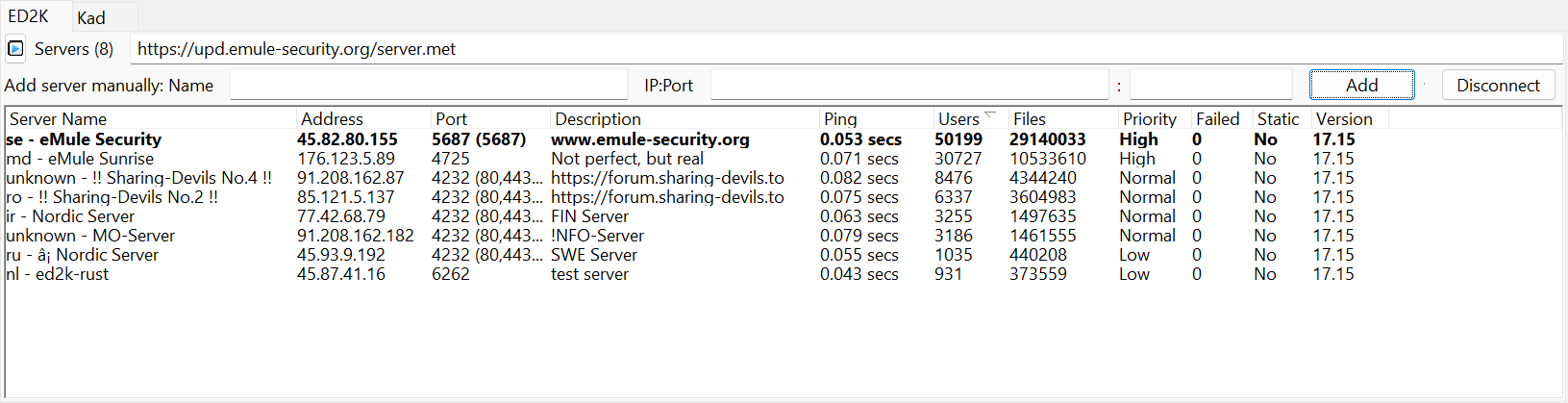
Wait until aMule reports a successful connection before searching; the status bar at the bottom of the window shows your eD2k server and Kad state once you are connected. For Kad, the Connect button is enough on first run; for manual control and updating your nodes.dat, see the Networks page.
High or Low ID
P2P networks need clients to reach each other directly, so a firewall or router that blocks aMule's ports can cause problems. Check the globe icon in the bottom-right corner of the window:

- Green arrows — you have a High ID and full connectivity. Proceed normally.
- Yellow arrows — you have a Low ID, which greatly reduces performance. You'll need to open and forward aMule's ports. See Network Connectivity for step-by-step instructions.
4. Search and download
Once connected, click the Searches button to open the Searches window. Enter a term in the Name field, pick a search type, and press Enter:
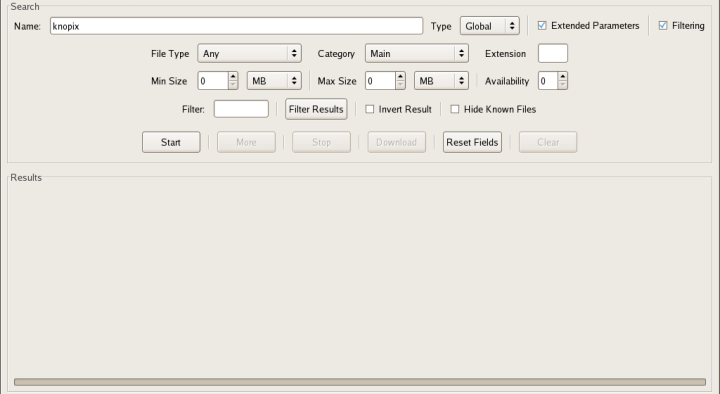
- Local — asks only the server you are currently connected to. Fast and usually enough.
- Global — asks every server in your list. Slower, but broader.
- Kad — searches the Kademlia network.
Double-click a result (or select it and click Download) to queue it:
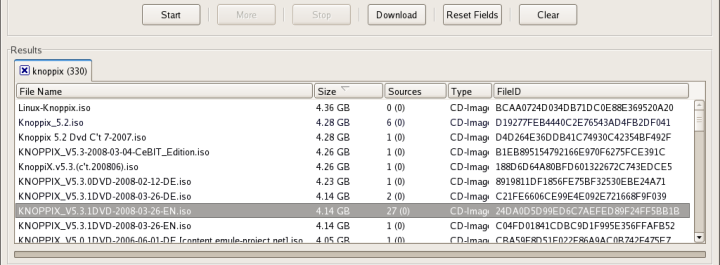
Results are colour-coded: blue = not downloaded (brighter blue = more sources), red = already in your queue, green = already downloaded or shared, magenta = previously cancelled.
The Searches page also supports Boolean expressions (AND, OR, NOT), file-type and size filters, and a regular-expression result filter.
5. Manage your downloads
Click the Downloads button to open the Downloads window and watch your queued files:
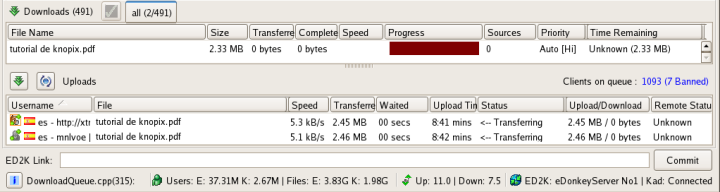
A quick way to read the progress bar: dark blue means many sources have the file, while red segments mean no known source has that part — those downloads are unlikely to complete. Double-click any file to inspect its sources.
The Downloads page documents the columns, source icons, and categories — named groups, each with its own colour and save folder — in full.
Where your files go
aMule keeps in-progress downloads in a Temporary directory and finished files in an Incoming directory. Both can be changed in Preferences → Directories; see Directories for the default paths on each platform.
6. Share files
It is your responsibility to ensure that you do not violate any laws regarding the material you share. There are two ways to share files:
-
Place files in your Incoming directory. Copy files there (see Directories for the path on your platform), then press the Reload button on the Shared Files page:

-
Add shared directories in Preferences. Open Preferences → Directories, browse to a folder, and double-click it to share it (or right-click to share it recursively, including subdirectories).
Next steps
You now have aMule configured, connected, downloading, and sharing. To go further:
- Graphical interface reference — every window, button and preference in detail.
- Configuration — directories, firewall, UPnP, proxy and more.
- Troubleshooting and the FAQ — for slow speeds, Low ID, and other common problems.
- Remote interfaces — run aMule headless (
amuled) and control it from a web interface or the command line. - P2P Networks — how the eD2k and Kademlia networks actually work.